Technology
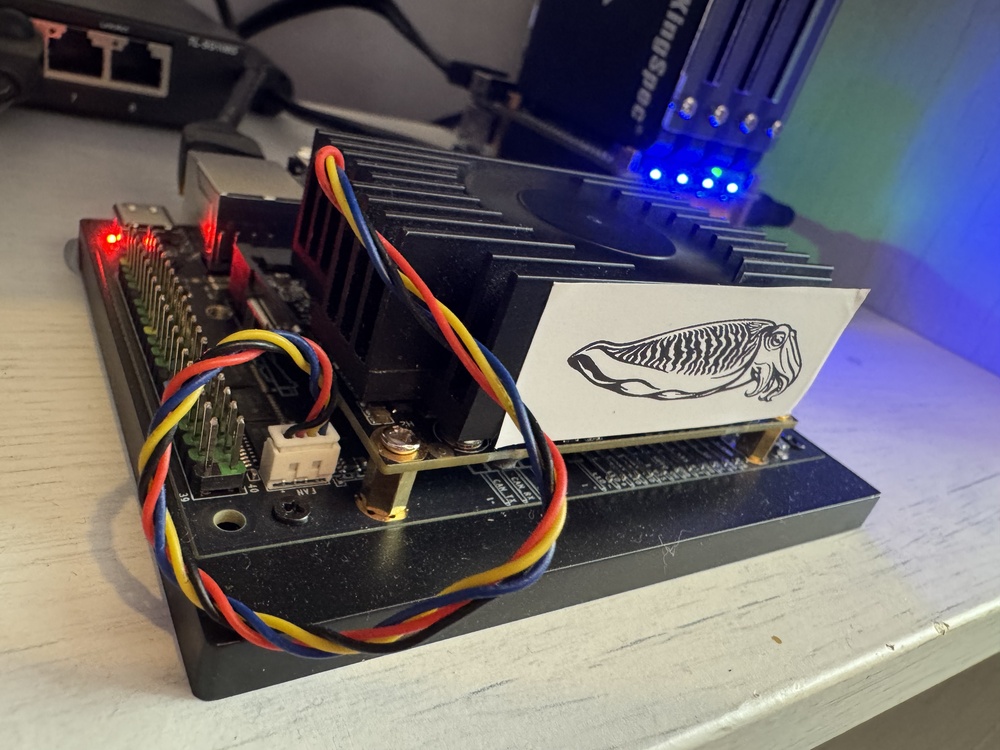
Agent Cuttlefish has lived on a number of different computers over the past year. Its current home is a Turing Pi RK1, with supporting services coming from a Raspberry Pi NAS and a Jetson Orin Nano.
Agent Cuttlefish is an ongoing artistic, technical, and research project. The agent combines open-source AI frameworks, large language models, agentic workflow systems, and custom-made software. A key design principle is the use of open-source software and openly available AI models wherever practical. The system is designed to be resilient and future-proof, with data stored in simple, widely readable formats, hosted locally and backed up regularly across multiple systems. Agent Cuttlefish also aims to avoid unnecessary dependence on proprietary platforms, hardware, and closed ecosystems.
Software
As of June 2026, Agent Cuttlefish runs on a technology stack built around Hermes Agent, Ollama, Open WebUI, and Astro. Hermes Agent orchestrates autonomous tasks and workflows, while Ollama serves locally hosted and cloud open-weight language models. Open WebUI provides the primary conversational interface, and Astro is used to build fast, static websites. Together, these technologies form a largely open-source, locally hosted infrastructure for creative AI practice, research, and experimentation.
-
Hermes Agent
github.com/nousresearch/hermes-agent
-
Ollama
github.com/ollama/ollama
-
Open WebUI
github.com/open-webui/open-webui
-
Astro
github.com/withastro/astro
Hardware
AI agents do not necessarily need power-hungry computers. Agent Cuttlefish currently runs on a Turing Pi RK1 board (aarch64, 8-core ARM, 16GB RAM) with a 256GB SSD. It runs 24 hours per day.
For advanced reasoning and language tasks, Agent Cuttlefish uses the Kimi-K2.6 model via Ollama Cloud, while smaller, local models can also run locally on the RK1 and a nearby NVIDIA Jetson Orin Nano system. This hybrid approach allows the agent to balance local control, low-power operation, and access to more capable cloud-based AI models when required.
The entire system is backed up regularly to a locally hosted Raspberry Pi NAS, helping ensure long-term resilience and recoverability of the project's data, archives, and software environment.
The medium-term goal is to power Agent Cuttlefish entirely locally, without the need for cloud AI models or services. I expect the price/performance of low- to medium-cost computers to allow this to happen by the end of 2027.